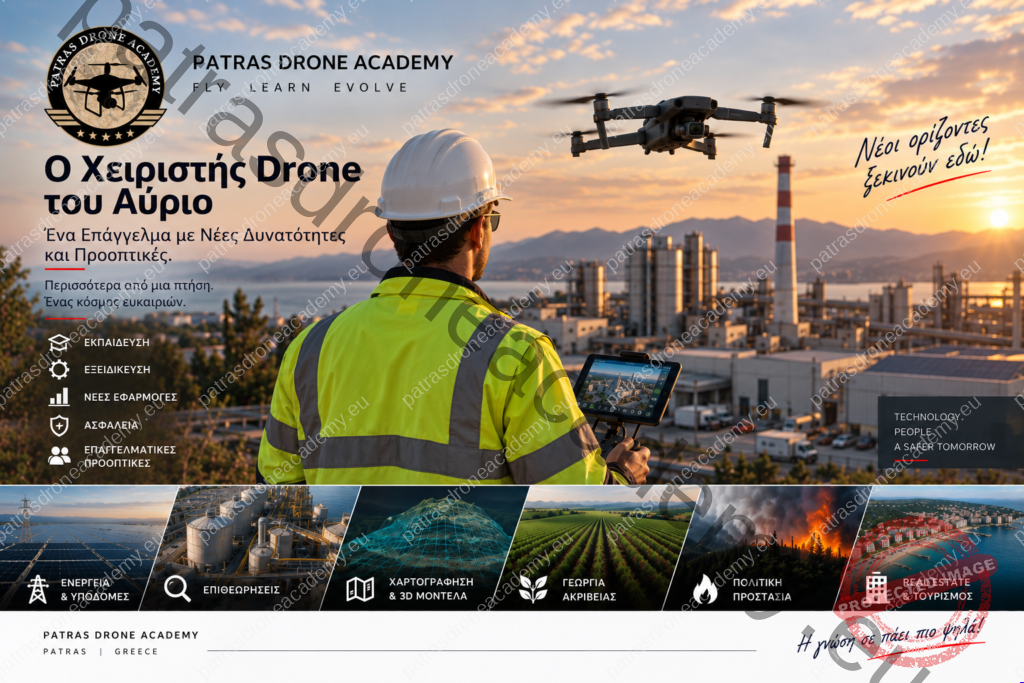
Until a few years ago, when we heard the word “drone,” most of us thought of a small flying device that captures impressive photos and videos from above. Today, however, things have changed significantly. Drones have moved from the realm of entertainment into everyday professional life and are now used in many different fields. Along with them, the role of the operator is also evolving. The drone operator of the new era has a career ahead of them that combines flight, technology, specialization, and a constant stream of new applications. And that is perhaps the most interesting aspect of this field: you learn to fly, but then you discover how many different things you can do with that knowledge.
It all starts with proper flight training
It forms the foundation for every pilot: takeoff, landing, proper maneuvers, responding to unexpected situations, and understanding the drone’s behavior—all knowledge acquired through training and hands-on practice. A trained pilot doesn’t just learn to move two sticks on a controller. They learn to think before flying, observe their surroundings, and make the right decisions. Confidence comes from flight hours and experience. But from there, a whole world of professional opportunities opens up. From a simple flight to a professional mission Today, a drone can be used for much more than just taking beautiful aerial photos. It can be used for facility inspections, photogrammetric surveys and mapping, and can be used in precision agriculture, energy infrastructure, monitoring large areas, thermography, research, and many other applications. This also opens up new opportunities for the operators themselves. Someone might start out simply because they love drones and flying, and along the way discover that they’re more interested in photogrammetry. Someone else might turn to thermal inspections, agriculture, or image production.
The operator gains expertise
As technology advances, so does the operator’s expertise—that is, when it comes to a drone equipped with a thermal camera. The flight itself is just the beginning. A professional must know exactly what they want to observe and how they will make use of the information they collect. The same applies to photogrammetry. A drone can capture hundreds of photos of an area, which can then be converted into maps, measurements, and 3D models. This is where technologies such as Geographic Information Systems (GIS) come into play, opening up even more possibilities. Thus, the operator can gradually evolve from someone who simply flies a drone to a specialized professional who provides a comprehensive service.
Artificial Intelligence Creates New Possibilities
Artificial Intelligence is also making a strong entry into this new reality. Drones can collect a massive volume of images and data. AI can help process this information, recognize objects or patterns, and draw useful conclusions more quickly. This means they will have even more tools at their disposal. The professional of the future will use drones, software, and artificial intelligence as parts of the same toolkit. Technology will make certain processes easier, but human factors—such as experience and sound decision-making—will continue to play the leading role.
Safety and Responsibility
Of course, as capabilities evolve, so does responsibility. The pilot must know where they can fly, what procedures to follow, and what restrictions to observe. Proper flight preparation includes checking the equipment, checking the weather, the flight area, and potential hazards, such as buildings, power poles, and other drones flying in the same area. For a professional pilot, safety is not merely an obligation. It is part of their professional identity.
A profession that is constantly evolving
Perhaps the biggest advantage for an aspiring drone operator is that they aren’t entering a static professional field. They’re entering an industry that is constantly changing.New drones, new sensors, better cameras, automated flights, GIS, aerial spraying, photogrammetry, and artificial intelligence are constantly creating new possibilities. Training, therefore, does not end with obtaining an Open A1-A3/A2 or Special Category certificate in Standard Scenarios (STS). That is essentially where the journey begins. The new pilot acquires the fundamentals, gains flight experience, and can then choose the field in which they wish to specialize.And this is perhaps the most optimistic message for the future of the profession. The drone pilot of tomorrow won’t just be the person behind a controller. They’ll be a modern professional who combines flying skills, technology, and specialized knowledge.

