What kind of drone license do I need? This is one of the first questions anyone who wants to legally fly a drone in Greece—whether for recreational or professional use—must answer. The answer depends on the drone, the flight mode, and the area where the flight will take place, as different requirements apply to the operator and the UAS operator.
But when you buy a drone, the same question almost always comes up:
“What kind of drone license do I need to fly legally in Greece?”
The answer depends on the drone you’re using, where you want to fly, and, most importantly, how you plan to conduct the flight.
Let’s take a look at them simply and in order.
Do I need a drone license?
In the European Union, drone flights are governed by a common European regulatory framework.
For most routine flights, the pilot operates in the Open Category.
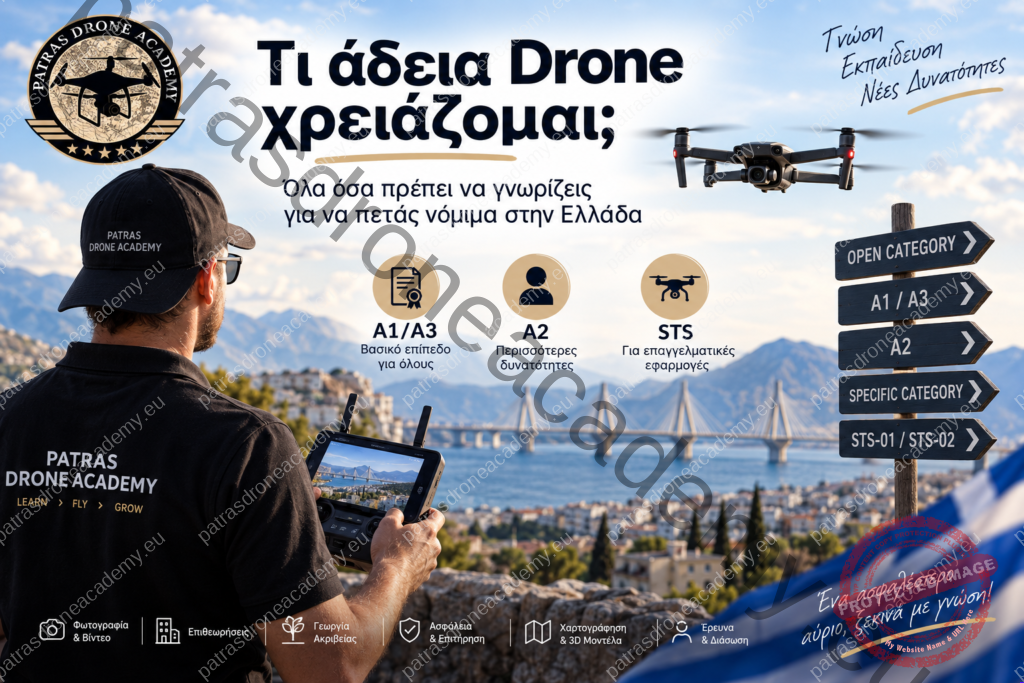
The Open Category is divided into subcategories A1, A2, and A3, with different requirements depending on the drone and the flight environment.
So there isn’t a single “drone permit” that covers everything.
There are different levels of certification and different operational restrictions.
What is A1/A3?
The A1/A3 is the basic certification level for a drone operator.
The operator is trained in basic topics such as:
- flight safety,
- airspace restrictions,
- human factor,
- business processes,
- technical knowledge of UAS,
- personal data protection,
- insurance and the basic requirements of European legislation.
For someone just getting started with drones today, the A1/A3 is usually the first step in their training and the first drone license they’ll need.
What is A2?
A2 is the next level in the Open Category and is intended for pilots who wish to fly under the conditions of the A2 subcategory.
It includes additional knowledge regarding, among other things:
- meteorology,
- drone flight performance,
- technical and operational risk mitigation measures on the ground.
A2 does not replace A1/A3. It is an additional level of proficiency and certification for the respective businesses.
I have a drone that weighs less than 250 grams. Do I need a drone permit?
This is one of the most common misconceptions.
Just because a drone weighs less than 250 grams doesn’t mean that “there are no rules.”
Depending on the drone’s specifications and how it is used, an A1/A3 drone operator license may not be required. However, flight rules, geographic zones, and other legal requirements still apply.
In addition, in many cases , the UAS operator must be registered . For those residing in Greece, registration is carried out through the Civil Aviation Authority (CAA) UAS Information Systemby submitting the UAS Operator registration application. Upon completion of the process, the operator receives their registration number, which must be displayed on the drones they operate in accordance with the applicable requirements.For example, when the drone is equipped with a sensor capable of collecting personal data, such as a camera, and does not fall under the relevant exemptions.
Therefore:
A drone weighing less than 250 g does not mean “I can fly wherever I want.”
Do I need to register as a UAS operator?
This is yet another point that often causes confusion.
The operator and the UAS operator are not necessarily the same thing.
The pilot is the person who operates the drone. The UAS operator is the individual or legal entity responsible for operating the drone.
When registration is required, the Operator receives a registration number, which must be used in accordance with the applicable requirements.
How high can I fly?
In the Open Category, the general upper limit is 120 meters from the nearest point on the Earth’s surface, subject to the more specific provisions set forth in the law.
However, the 120-meter limit does not mean that every area below that altitude is automatically available for flight.
There may be restrictions due to:
- airports,
- military installations, protected or special areas,
- temporary restrictions,
- other UAS geographic zones.
That is why a thorough inspection of the area is part of the preparation for every flight.
How far can I fly the drone?
In the Open Category, the basic rule is to fly within VLOS (Visual Line of Sight).
Simply put, the operator must maintain constant visual contact with the drone so that he or she can control its course and identify other hazards in a timely manner.
There is no general rule stating that “all drones are allowed to fly up to X meters away.”
The mere fact that a drone is capable of transmitting images or signals over many kilometers does not, in and of itself, constitute authorization to conduct such a flight.
A different operational framework is required for beyond-visual-line-of-sight (BVLOS) operations.
What if I want to use the drone for professional purposes?
European legislation does not simply distinguish between “recreational” and “commercial” flights.
The key factor is the risk and the manner in which the operation is carried out.
Thus, in certain cases, a professional may perform a job under the Open Category, provided that all of its requirements are met.
However, there are professional businesses that go beyond the limits of the Open Category. In that case, we move on to the Specific Category.
What are STS-01 and STS-02?
STS (Standard Scenarios) refer specifically to standardized business scenarios in the Specific Category.
STS-01 pertains to VLOS operations under specific conditions, while STS-02 pertains to specific BVLOS operations with airspace observers and the corresponding restrictions of that scenario.
For professional pilots who want to move beyond the basic operations of the Open Category, training in the Specific Category can be an important next step.
Is a certificate enough to make me a good operator?
No.
Theoretical knowledge and certification are essential, but an operator’s actual skill is also developed through flight training and experience.
A properly trained pilot must be able to handle not only a normal flight but also situations such as:
- change in the weather,
- loss of communication,
- GNSS issues,
- low battery level,
- obstacles,
- the unexpected presence of people or other aircraft,
- emergency procedures.
It’s easy to learn how to take off with a drone.
Knowing how to conduct a safe and properly planned flight is what sets a trained pilot apart.
What kind of drone license do I need as a first step?
If you’re just starting out, don’t just try to get “a piece of paper.”
First, you need to know what kind of drone you’ll be using and what kind of flights you want to make.
This leads to the appropriate training path:
A1/A3 → A2 → and, when operational needs require it, Specific Category / STS.
At the Patras Drone Academy, training is not viewed merely as a process for obtaining a certificate.
The goal is for the new pilot to understand the regulatory framework, learn how to plan a flight properly, and, if they wish to pursue a career in aviation, acquire the knowledge and flight experience required for the next level.
Because the right question isn’t just:
“What kind of drone license do I need?”
It is:
“What do I want to do with my drone, and what training do I need to do it correctly, safely, and legally?”
Drone Pilot Training | A1/A3 | A2 | STS-01 | STS-02 | Flight Training

