European drone regulations have been established by the EASA (European Union Aviation Safety Agency) and are applied uniformly across all member states. This framework is based on the level of risk associated with the flight, rather than simply on the weight or type of the drone.
The philosophy of the EASA regulatory framework
EASA categorises flights into:
- Open (Open)
- Specific (Specific)
- Certified (Certified)
The first two concern the largest proportion of private and professional operators, while the third had not yet been activated
Α. Open Category (Open Category)
The Open Category is for low risk flights, without the need for a prior operating licence, subject to certain restrictions, serving for :
- Amateur use
- Basic business flights
- Low complexity downloads and missions
- Flights away from crowds of people
Obtaining the Open Class is the simplest procedure within EASA and includes:
- Register at as operator (Operator Registration)
The person concerned registers with the National Civil Aviation Authority of his/her State as an SFE operator and receives a unique registration number (Operator ID).
- Theoretical training
Requires basic theory from a school for knowledge covered:
- air traffic rules
- flight safety
- airspace restrictions
- personal data protection
- human factor
- GPDR
- Secure
- Protection against unlawful acts
- General Drone Knowledge
- Air Traffic
- Meteorology
- Flight Performance
- Theoretical examinations
The operator shall be successfully tested:
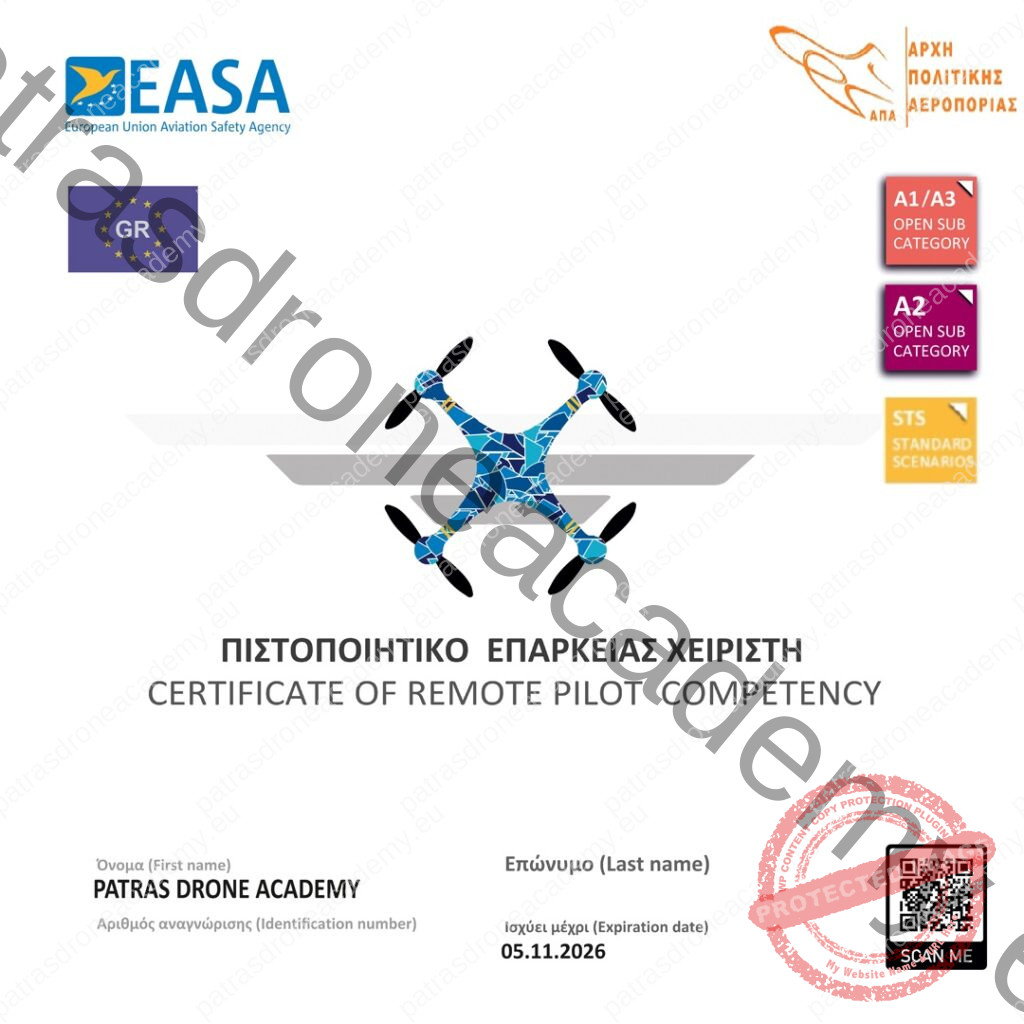
- A1/A3 for basic flights
- A2 for flying closer to people, through Proctor Exam or by physical presence on the school premises
- Declaration of compliance
The operator declares that he/she is aware of and complies with the restrictions of the Open Class.
Β. Specific Category (Specific Category)
The Special Category is for medium to high risk flights, which are not allowed in the Open Category
& I usually need it in:
- Flights in an urban environment
- Flights near or over people
- Flying out of visual contact (BVLOS)
- Professional businesses with increased requirements
All it takes is ONE negative answer to the basic restrictions of the Open Tier to be automatically transferred to the Special Tier.
The Open Tier is based on compliance with certain limits.
The Special Tier is based on risk management, not absolute restrictions.
With a quick interpretation:
- ✔️ Simple flight, low risk → Open
- ❌ Urban environment, people, BVLOS → Special
- ❌ Exceeding even one threshold → Special
How I get the Specific Category
The process of obtaining the Special Category is more complex and demanding, as it focuses on risk analysis and management.
- Choice of flight authorisation mode
There are two main routes:
- Standard Scenarios (STS)
EASA predefined operational scenarios, with specific conditions and technical requirements. - SORA (Specific Operations Risk Assessment)
Detailed risk assessment tailored to the specific operational scenario.
- Theoretical and flight training
The operator must complete:
- advanced theoretical training in live courses, on-line
- flight training in operational scenarios:
- Pre-flight planning (Pre-flight planning)
- Operation of flights with operational restrictions
- Flying in a high-risk environment
- Training in emergency procedures
- Emergency management (Emergency procedures)
- Implementing STS or SORA in practice
- Operator evaluation
The It is training with airline logic.
- Operator assessment and certification
The competent authority or approved body:
- assesses knowledge
- examine the flight capability
- confirms compliance with the approved scenario
- Approval of an operating licence
The licence is issued by the National Civil Aviation Authority & EASA and covers:
- specific type of flights
- specific conditions and restrictions
Which category is right for me?
- Open Category: for simple, limited and low-risk flights
- Specific category: for professional activity, urban environment and complex businesses
In practice, the Special Category is an evolution of the Open Category, not a replacement for it.
The Special Category is based on logic:
“I allow you to fly because you can prove that you control the risk”
Where can I get certified?
The certification is carried out through:
- National Civil Aviation Authorities
- Approved examination and educational institutions, under state supervision
Pilot certificates issued under EASA are valid in all EU Member States.
A proper understanding of drone categories and certification procedures is essential for every operator.
EASA legislation offers clear pathways to legal, safe and professional activity, depending on the level of risk and operational needs.

